
Photo by Benny Rotlevy on Unsplash
Or, “Is Google Poised for a Crackdown on AI Slop Content?”
AI-powered slop sites that pose as neutral local news outlets now outnumber daily local newspapers in the United States.
For those of you who keep tabs on the topic, you’ll know that’s an old headline. We first crossed that threshold back in June 2024.[i] Today that gap widens, as research verifies that 300 to 500 new AI slop news sites crop up each month, with a fair share bogusly posing as local news operations.[ii]
What’s in it for the people who prop up slop news sites? Historically, two things: pumping ad platforms for profit and rendering disinformation for dissent.
A couple examples:
AI slop news sites siphon money from ad platforms, like Google Discover. Some have raked in millions for cagey editors.[iii]
Other sites, like those run by the pro-Russian influence operation Storm-1516, churn out false and misleading content on websites designed to look like local newspapers in the United States and Europe.[iv]
And what’s in it for the rest of us?
Outright harm. As fronts for scams and hubs of disinformation, they drown out legitimate news and degrade trust in one fell swoop.
It’s why I picked these sites as the focus for this blog. While the slop that floods ads, social media posts, and citation-farming content makes our eyes roll, this slop is malicious.
As we point to cases for cracking down on slop this one stands tall among them.

Photo by Pedro Aguilar on Unsplash
Now, how does Google factor in?
Well, as AI slop news sites choke out legitimate news sites like weeds, recent developer guidance from Google could bury them deep in the downranks of SEO and GEO.
If Google’s track record stands, its guidance published earlier this month signals that the company will soon take square aim on AI slop content—and penalize it accordingly.
We’ll cover what Google said and what it might have in store shortly.
Yet the larger story here revolves around what Google’s possible moves mean. Not just for slop overall, but for broad access to legitimate sources of news—in a time when that access is dying out.
As Local Journalism Dies, News Deserts Rise
Americans have lost access to journalistic sources of news as thousands of local papers have drastically cut coverage or shuttered altogether.
Since 2005, roughly 3,500 local papers have closed and counting. Once holding onto a sad and steady rate of decline, that rate of loss has since jumped, as illustrated below.
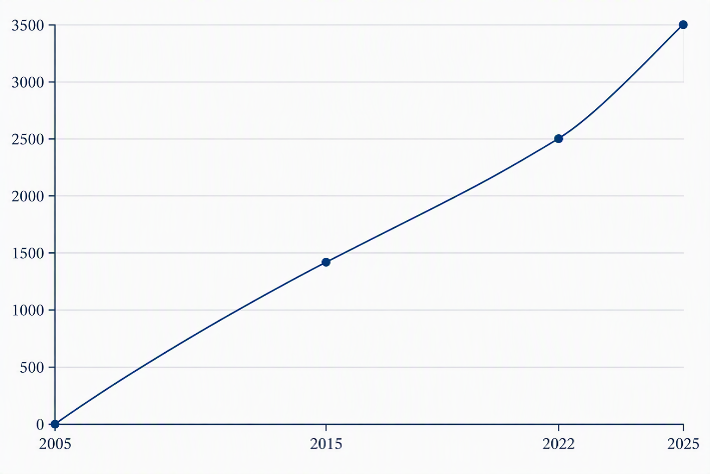
Loss of U.S. Local Papers, 2005-2025—Northwestern University Data
From 2022 to 2025, the U.S. lost roughly 1,000 papers across the country.[v] Three years, 1,000 papers. Yet across 2015 to 2022, it took seven years to lose 1,000 papers.
Loss rates aside, roughly 50 million Americans now live in regions with no source of local news. That means 15% of our population find themselves deprived of the info that directly impacts their day-to-day lives—the events, issues, developments, and human-interest stories that make their community feel like a community.[vi]
What’s left … sprawling news deserts, places where Americans increasingly lack news that squarely focuses on who they are, where they live, and what matters to them.
Yet the desert doesn’t end with newspapers. It extends to broadcast as well.
Once Oases of Local News, Public Broadcasting is Drying Up Too
Even as newspapers folded over the last quarter century, public radio remained. At its peak, public broadcasting provided local news to 82% of regions with no other local news presence and to 90% of regions with only one other source of local news.[vii]
Now, with the federal defunding of public broadcasting, those news outlets have shrunk, found themselves in jeopardy, or ceased operations altogether.
Per Protect My Public Media:
“Stations have cut local programs, canceled educational outreach to families, laid off staff, and in some cases, have terminated over-the-air service. The scale of staff reductions varies by station, with some reporting cuts of more than 50%. Some stations are down to single-digit staff. A few newsrooms have been reduced to a single reporter covering vast rural regions vulnerable to natural disasters.”[viii]
How many public broadcasters will survive the prolonged effects of defunding, and in what fashion, remains to be seen. Yet any loss of public radio only casts more Americans into the news desert while other local coverage dries up.
So, Where Do People Turn for Local News?
Non-journalistic sources and hearsay, according to research from Northwestern University.
In the wake of shuttered papers and defunded public broadcasters, people increasingly get their local news from non-journalistic sources like Facebook groups, YouTube videos, and social media influencers.[ix]
Oh yes, and search. Where slop sites juice their content for clicks.
Northwestern University Research Study, 2025
Pew Research uncovered similar findings. As of Fall 2025, 38% of U.S. adults say they regularly get news on Facebook, and 35% say the same about YouTube.[x] Arguably, Facebook and YouTube include a mix of journalistic and non-journalistic sources depending on a person’s feeds, follows, and subscriptions, which sets this research apart from that of Brown’s.
Yet these findings fit within additional research from Pew, where 56% of U.S. adults say they often get their news from a digital device.[xi]
Clearly, people’s desire for news hasn’t quelled. They just turn to alternative sources to get it. And with the rise of AI slop news sites, their news sources increasingly lack journalistic rigor and editorial oversight.
In short, as specious sources of news outstrip legitimate sources, Americans risk consuming slop that profits from their eyeballs—or worse, poisons their minds.
Now, enter Google.
What is Google Doing About AI Slop?
The recent Google developer guidance mentioned earlier speaks plainly.
Typically, significant updates to Google’s developer guidance signal programmatic changes in SEO and GEO. And three statements made by Google earlier this month take square aim at what it calls “scaled” content, which is AI-generated content in general and the kind of AI slop we’re talking about in particular here.
The updates read like this:
“It is critical to manually factcheck and review all AI-generated content for accuracy and trustworthiness before publishing.”[xii]
“...using generative AI to produce large amounts of text without manual oversight or curation represents little to no effort.”[xiii]
“Fabricating creator profiles (such as by using AI-generated headshots, made-up names, or false credentials to make content appear as if it was written by human experts) is a form of deception. Any form of deception makes a page untrustworthy to both users and our automated quality systems and is a signal of a low-quality page.”[xiv]
These statements could auger potential changes that will downrank AI slop news sites and slop content overall. When? To when extent? We’ll see, yet this guidance sings like a canary in Google’s coal mine. History says changes are afoot. With Google, guidance presages deeds.
More broadly, I hope this signals an ongoing commitment from Google that all “scaled” content must face scrutiny, lest it pollute the internet yet more and choke out still more legitimate and thoughtful voices, journalistic or otherwise.
Until then, I’m waiting for Google’s other shoe to drop … right on the snouts of AI slop farmers.
Which brings us to a closing question for the umpteen other platforms out there: what moves will you make?
Thank-you to …
Lily Ray for the Google summary—and her full prediction for the next massive Google update absolutely calls for a read.Also, for an excellent overview on what constitutes “effort” for Google, check out Cyrus Shepard’s blog that covers content effort and how it affects ranking.Sources:
[i] https://www.newsguardtech.com/press/sad-milestone-fake-local-news-sites-now-outnumber-real-local-newspaper-sites-in-u-s/
[ii] https://www.newsguardtech.com/press/newsguard-launches-real-time-ai-content-farm-detection-datastream-to-counter-onslaught-of-ai-slop-in-news/
[iii] https://wan-ifra.org/2026/07/hes-found-15000-fake-ai-news-sites-heres-what-you-need-to-know/
[iv] https://www.newsguardtech.com/press/newsguard-launches-real-time-ai-content-farm-detection-datastream-to-counter-onslaught-of-ai-slop-in-news/
[v] Ibid.
[vi] https://localnewsinitiative.northwestern.edu/projects/state-of-local-news/2025/report/
[vii] Ibid.
[viii] https://protectmypublicmedia.org/blog/2026/06/03/a-year-after-defunding-concerning-trends-at-local-public-media-stations/
[ix] https://localnewsinitiative.northwestern.edu/posts/2026/02/10/news-deserts-social-media-local-news-medill-survey/index.html
[x] https://www.pewresearch.org/journalism/fact-sheet/social-media-and-news-fact-sheet/
[xi] https://www.pewresearch.org/journalism/fact-sheet/news-platform-fact-sheet/
[xii] https://developers.google.com/search/docs/fundamentals/using-gen-ai-content
[xiii] https://developers.google.com/search/docs/fundamentals/creating-helpful-content
[xiv] Ibid.